sources about the problem of new media
Joseph Gordon-Levitt states the problem with narrative on emerging media (specifically VR) at Sundance. This is really close to my statement of new media as a blend, and he starts to talk about the role of the spectator and narrative effect/function.
The Motion Capture for the words in the street shot did not turn out as well as I hoped. Especially when you put it next to a motion poem like this:
I kind of envy the flow and camera freedom.
I was thinking something that was closer to the goose's feet might speed up the tempo. I think there is some sort of mental POV shot (Barsam 100) like this that is used to transition from one environment to another, but I cannot find a reference.
I have noticed parody movies are pretty good for analyzing cinematic communication because they over emphasize typical devices for comedic effect.
Shaolin Soccer uses conventional editing techniques, but stretches the suspension of disbelief to a ridiculously unexpected extreme to mock the action film genre
The climax of Shaolin Soccer
Use of point of view editing
The cinematographer shows a series of progressively tight shots of a corner of the goal to communicate that the kicker is aiming for the tight corner and an eyeline-match cut of a look of determination to show the conflicting moral positions. This is a classic example of point of view editing.
The movie follows with separation editing (cuts between 2 or more characters to show conflicting goals). (Barsam 313)
Illocution of the Scene
explicit - the kicker (and by extension the protagonist's team) are facing a bigger problem than they are prepared for
implicit - popular action films exploit the audience's naivety
Perlocution of the Scene
explicit - the protagonist have a virtuous naivety
implicit - a sensation of humor and identification through the parallel naivety between the audience and the protagonist
Barsam, Richard M. Looking at Movies: An Introduction to Film. New York: W.W. Norton, 2004. Print.
Barsam's example of separation editing is this scene from The Shining
I am a little inspired by Lumnio City. The game environment was built and shot, and the characters were animated over using a lot of the same techniques I am using.The look of the environment is unmistakably real, and captures the aesthetic of a small handmade environment with a prominent short depth of focus and the texture of the paper.
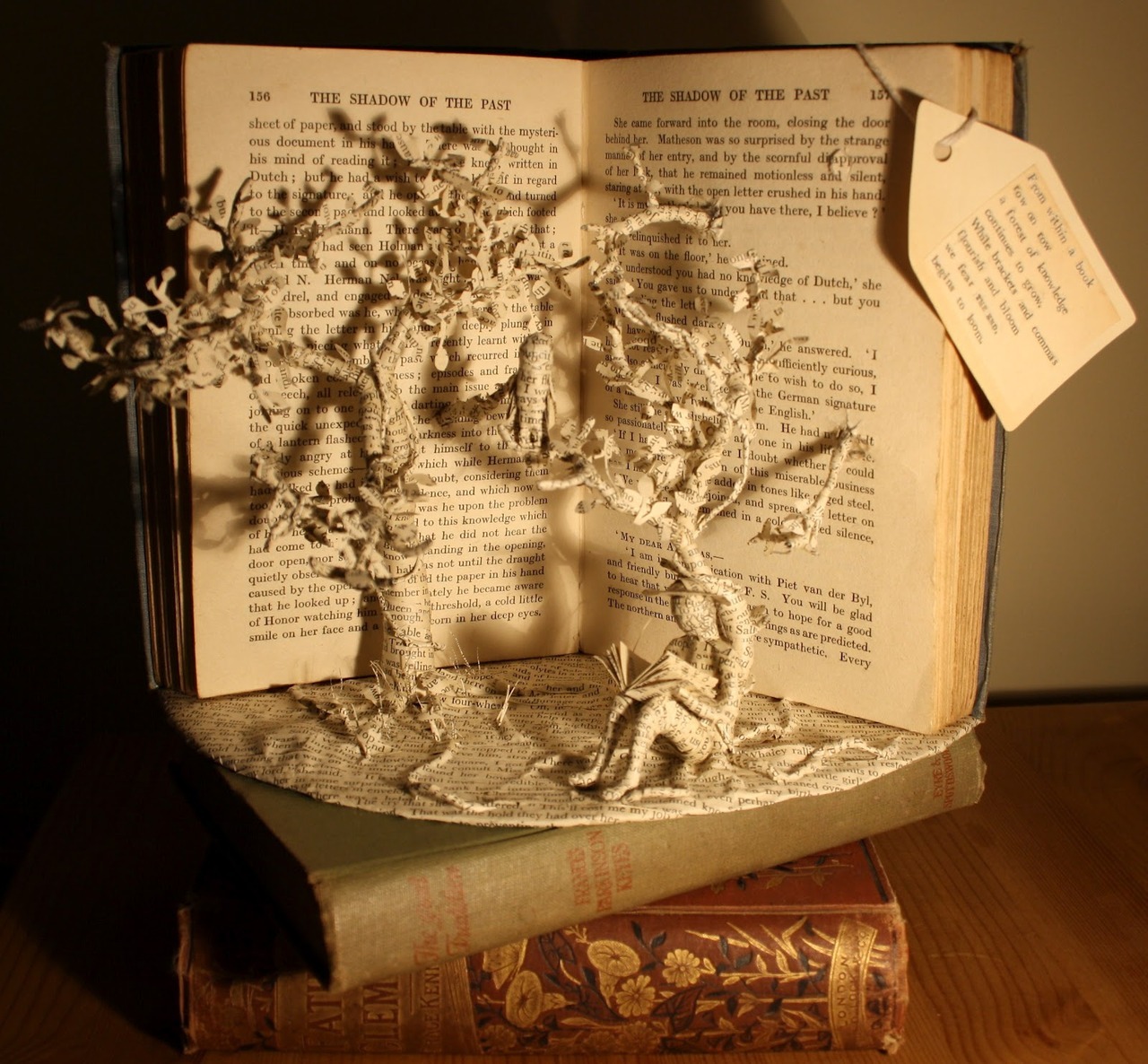
I was thinking a similar technique mixed with a book sculpture might add more interactivity while enhancing the feel of a book.
I guess I didn't really have a form unique to mixed media in the "Of Geese and Finance" shot, but I think I have one in the "Butcher Shop Interior" and "Panhandler" shots.
I am not sure what kind of function the "Butcher Shop Interior" is. It sort of changes from implicit to explicit as the text transforms into characters. All of my cross over tropes sort of go from constative to performative by virtue of swapping dialects between literary and cinematography through interactivity. In a sense they were never really performative functions, because they were never purely constave in the other platform. But that leads back to the problem that you cannot make a statement to another without eliciting some sort of reaction (or it is not really communication). In that light, the crossover performative functions are more perfect than a performative function in a single platform because they do not exist as statements at all in the other medium... But that might make them less than utterances.
I don't think a constative utterance can exist, but performatives are a gradation from implicit to explicit, and time based media can go from not existing -> to implicit -> to explicit as the message is revealed to the audience.
My focus right now is on blending mediums to make a from unique to the hybrid medium. I am taking Motion Capture this semester, so I could make acting text.
This is the Scene with the panhandler. I have made some adjustments to the environment so that I could walk through it as the test, behind the goose, with the street footage projected on an object for reference. This version is not animated, but I will make one with a tiff sequence for the capture session.
Thought I would try a dolly zoom with text for a mixed media project. Not a resounding success. A dolly zoom really needs an environment to be successful.
This semester I am focused on creating a form that blends cinematic animation, interactive media, and literature in a complimentary way. The shot that I am working on now is the interior of the building Tuba-Goose entered last semester. I am changing the location to a butcher shop because it adds to the dramatic effect, and horror films have a lot of paradigmatic camera and lighting techniques that would be interesting to apply to another medium. I thought it would be complimentary mix of media to make the interior all narrative text (people , shelves, everything except the goose would be extruded polygonal text), use motion capture to animate the people, and use a dolly zoom for a shot where the goose sees the butcher doing what butchers do.
I am not sure how I will texture everything or how I will organize the words so they function as characters and are readable as text, but I think motion capture will add an inherently human quality to the movement that should give me more freedom to deviate from anthropomorphic shapes while relaying the intended actions. I am hoping that when I have the movement for the scene, I will be able to create a model based on the text and the key frames that becomes reveals itself to the reader in a way that alludes to the internal dialogue of the goose when he realizes what is going on in the butcher shop (I want the audience to be thinking "Is that a person chopping off the head of... YES IT IS!" in parallel to the character's realization). This shot does not do much to exploit interactive media, but I am worried compounding too many distracting elements (e.g. putting a tilt interaction, prompting an expand gesture on the touch screen, or something of that nature) would drown the humble, quiet nature of a book.
The narrator and the cinematographer share the stage in this animation in a way that I really like. The tone is also similar to what I would like to achieve.
I think it is dactylic tetrameter. Dactil (Stressed + Unstressed + Unstressed) Tetrameter (four groups)
But it ends in an iamb (a short syllable followed by a long syllable)
The most believable responses are reactions from real people to unscripted scenarios, not actors. That is why I am trying to get authentic reactions from people, and edit the goose into the footage. As an extension, I have been working on a teleprompter for unwitting actors.
Goose Vision
I want the audience/viewers reaction to be surprised and exclamatory; something like "Is that a goose with a tuba?!", and not "what is this for" or "How did you make it 3D?". So I am trying to absorb the character in the viewers space, rather than trying to adapt the viewer to the characters world.
The display is 3D (without glasses) with parallax, and the background is from a camera behind the monitor.
The interlacing takes up a huge amount of the processing power, so the live version will have only a few responses, triggered manually (AI reactive responses are slower, and they are unreliable as the input cycles overlap the processing).
The Kinect 3D Sensor
The Kinect generates a lot of information about the environment, it might also be useful in defining the camera's position in the virtual space and grabbing a quick 3D model.
The two limiting factors for outdoor are sunlight, which has a lot of infrared (the Kinect tracks depth with an array of IR laser beams), and the Kinect is only designed to range objects within 10 to 20 feet of the sensor. I am looking into lenses and filters for both issues.
The Microsoft SDK (seen above on a running on a laptop) is very stable, but it does not communicate with Isadora, so I could not use it to do head tracking in the field, but it might be useful for making a live 3D map of the camera position.
This one is terrible. Not like a book at all; this is a Flash game with some words in it. It is like they wanted to increase your kid's ADHD. But I like the candle illuminating text on the floor.
If the character is walking left (returning from a right facing action), the text following the character would have to go in the other direction. This action reversal is unlike a book, so I am looking into ways to compensate, without crossing the line of action.
This shot works, the text is in the background on the wall, so the wall needs to be photo realistic.
These are test shots, so the background is just a low resolution representation, the tuba is missing the ring around the lip, the connector ring is not beveled, the shadows are a bit low resolution, and there are a few details on the tuba that are missing to speed up render time.
I didn't realize that the goose would need to be going the other direction for this shot to swipe right until after I rendered the first test shot, so I reversed the text. I mirror a lot to compensate for the side the tuba is on, so I think it will pass.
It's kind of hard to see, but there is a flying V of text that says "Regular Goose"
Neither texts read well... So, I guess what I got out of this is:
1. To preserve the line of action and the swipe direction, I should use text following the goose to go left and text on the background to go right...
2. Pick a more readable font for graffiti and a flatter surface for reflection text...
Stuff to build on or a way someone might use my research???
when I find a scene that is final, I will go out with a light probe and make an environment sphere, but if you just want to make test shots, and the environment sphere is really important because your object is highly reflective; this saves the time of going out to shoot an environment sphere for each test shot.
I have played around with light painting, and I have some Blinky-tape. It is a beautiful effect, but it it can only be done at night, and it requires a long exposure, so animation cannot be done live, only in stop motion.
I haven't been posting much this week because I was putting together a Power Point presentation for class on Monday.
The feedback I got from faculty was very helpful. It didn't really dawn on me that the text was beginning to anthropomorphize until yesterday, so now I am starting to think of it more like a character.
It was suggested that I change the font, and I am starting to think about how and when it should move to imply cognition, personality, and intent.
My initial ideas;
I was going to try to make it look like the words are dawdling in the shot where it is following the goose (like a train of goslings, or implying a meandering mind).
I was thinking the exclamation mark might shake like a fist in the air as the words "Who Let that animal in here!?!?" is chasing the goose out of the store.