Showing posts with label Locution. Show all posts

Sunday, March 19, 2017

More on Locution vs. Constative

The constative is a conceptual form; it is a statement without implication.

Locutionary concerns include
  • spelling and grammar 
  • tonal qualities of the music (i.e. that note doesn't belong there because the song is in the key of F)
  • technical issues
A distinction between Constative and Locutionary is clear in the performative breakdown of the text in scenes 7 and 8.
Scene 7
Locution
Some of the words with strong syllables waddle across the screen with characteristics that suggest the words meaning. The poetic meter is anapestic with the substitution of a trochee (one long or stressed syllable followed by a short or unstressed) for an iamb (short or stressed followed by a long or unstressed), causing a speeding up (Corn 41). The poetic meter breaks in the words behind, people, goose, and tuba.

So he did (soft, soft, hard)
Or he tried (s, s, h)
And he left (s, s, h)
Geese behind (h, h, s)
To show people (h, s, h, s)
A goose (s, h)
With a tuba (s, s, h, s)
Illocution
This is a whimsical story about a goose who thinks he can be a human
Perlocution
A light-hearted tone is established. The stumbling verse is reminiscent of a gooses waddle, with a stumble for subtle dramatic emphasis (the word goose does not follow or fit into the poetic meter of the rest of the segment).
Primitive
Stumbling verse with a whimsical subject and variation in meter; shaping a lines rhythm so that it will support the conceptual content (i.e. interpreting visual imagery to evoke an emotional response through linking aesthetics with conceptual conjugates).
Constative
The goose is entering the human world.
Explicit Performative
Function
Establish character and story as whimsical, and foreshadow character’s problems
(The general performative functions of foreshadowing: An audience forgives plot turns when events have a certain degree of predictability (not completely unforeseeable, but somewhat challenging). It adds sense of a master plan to everything.)
Implication
The poetic imagery does not involve a confusion. There is a moment of interpretation, but it is not like a dolly zoom (it does not rely on tension)

Locution - form
Constative - statement without implication
Performative function - how the scene furthers the audience's understanding of the story
Perlocution -  psychological change in the audience


Corn, Alfred. The Poem's Heartbeat: A Manual of Prosody. Port Townsend, Wash: Copper Canyon Press, 2008. Print.

Tuesday, November 29, 2016

Collage Approach


The text in this scene was made by cutting and pasting pieces from other texts to stitch together a narrative.

Saturday, August 27, 2016

Illocution, Perlocution, and Primitive for the Acceptance Chapter


Illocution: Tuba-Goose is not a goofy comedy or a fairy tale, it is a metaphor for the dissonance one feels when they realize their limitation through failure to attain a dream. It is a personal message to the adults to remember the moment when you realized that you could not be anything, if you try hard enough, and a foreshadowing to the child audience.

Primitive: I want the story to transition from a tongue and cheek story about a goofy character into an embarrassing failure in the real world. The primitive I want to incorporate is the uneasy feeling the audience feels watching someone bomb on a stage, evoking the embarrassment someone feels watching a performer try to do something that they are unwilling to accept that they do not have a skill for.

Something Big from Found Footage Festival on Vimeo.

Perlocution: The audience's embarrassment turns to sympathy and a recognition of the humanity of the goose when he that he has failed (i. e. identification with the protagonist).

I planned to shoot ComFest, and local shows for looking for footage of an uncomfortably bad public performance in which to add the Goose. I have some performances that are pretty awkward and mortifying, but what I have needs audio to work, and I can't think of a way to integrate it into the form.

Friday, August 19, 2016

The Key Points of Speech Act Theory

I found one of the best summaries of the points of Speech Act Theory in The Blackwell Guide to the Philosophy of Language.
visible off campus here.
Devitt, Michael, and Richard Hanley. The Blackwell Guide to the Philosophy of Language. Malden, Mass: Blackwell Pub, 2006. Internet resource.


It also mentions P.F. Strawson who I was excited to learn thought "most illocutionary acts involve not an intention to conform to an institutional convention but an intention to communicate something to an audience". Unfortunately, after further investigation , it appears his research was not going into a direction that would be useful in the creation of a logical structure based on linguistics. 

"there is no requirement to map ordinary language onto artificial logical structures, nor does that capture ordinary meaning anyway. "  
-Strawson (http://plato.stanford.edu/entries/strawson/#Lan)
"his slogan that ordinary language has no precise logic". 
-Strawson  (http://plato.stanford.edu/entries/strawson/#Lan)

Saturday, March 19, 2016

Structure of Humorous Communicative Effect


It includes a map of the role of emotions in information processing.

E = N (I − I0)

"E is the emotion strength, N is a strength of some need, I0 is the quantity of information demanded for the satisfaction of this need, I is the quantity of information the subject has at his disposal (both informations are estimated subjectively). An emotion is positive (E > 0) for I > I0 and negative for I < I0."


Computer Model of a "Sense of Humour". I. General Algorithm. , n.d.. Internet resource.
http://arxiv.org/abs/0711.2058

Wednesday, February 24, 2016

Short Dolly Zoom

An extremely close wide angle to medium dolly zoom has a surprisingly comical effect

Sunday, February 21, 2016

The Power of Joseph Campbell

My approach is based on the premise that resonance is a pattern that can be mapped reproduced. I am not suggesting quality can be evaluated or engineered with a formula like Komar and Melamid, but forms like the hero's journey and characteristics of protagonist vs. antagonist reoccur and can be as a reference to analyze and inform the creation of narrative work.
Joseph Campbell's theories were used by George Lucas to add a legendary epic quality to Star Wars, and I hope that analysis of similarities across mediums can be used to enhance and preserve aspects in a mixed medium. My project is testing this idea with a user driven animation that is attempting to preserve the intimate charm of a book while communicating in a way unique to the new form.

Motion Capture vs Motion Poem

The Motion Capture for the words in the street shot did not turn out as well as I hoped. Especially when you put it next to a motion poem like this:
I kind of envy the flow and camera freedom.

I was thinking something that was closer to the goose's feet might speed up the tempo. I think there is some sort of mental POV shot (Barsam 100) like this that is used to transition from one environment to another, but I cannot find a reference.

Tuesday, February 16, 2016

Saturday, February 13, 2016

Using Parody Movies to Analyze Cinematic Phrases

I have noticed parody movies are pretty good for analyzing cinematic communication because they over emphasize typical devices for comedic effect.

Shaolin Soccer uses conventional editing techniques, but stretches the suspension of disbelief to a ridiculously unexpected extreme to mock the action film genre

The climax of Shaolin Soccer


Use of point of view editing
The cinematographer shows a series of progressively tight shots of a corner of the goal to communicate that the kicker is aiming for the tight corner and an eyeline-match cut of a look of determination to show the conflicting moral positions. This is a classic example of point of view editing.
The movie follows with separation editing (cuts between 2 or more characters to show conflicting goals). (Barsam 313)


Illocution of the Scene
explicit - the kicker (and by extension the protagonist's team) are facing a bigger problem than they are prepared for
implicit - popular action films exploit the audience's naivety

Perlocution of the Scene
explicit - the protagonist have a virtuous naivety
implicit - a sensation of humor and identification through the parallel naivety between the audience and the protagonist 


Barsam, Richard M. Looking at Movies: An Introduction to Film. New York: W.W. Norton, 2004. Print.

Barsam's example of separation editing is this scene from The Shining

and POV editing is this scene from The Birds

Friday, February 12, 2016

Another Dolly-Zoom Prototype

I think I should have left the "See" letters fixed. I attached them to the face so they could look at the camera, for dramatic effect.
This might work better if the text was black and the word was color, but I want the imagery to unfold. Maybe if they switch places, like the world starts white (with the texture of paper), and the text is color; then the text turns color, and the world turns black.

Wednesday, February 10, 2016

Integrating Interactive the aesthetic of a Book and Interactive Media

I am a little inspired by Lumnio City. The game environment was built and shot, and the characters were animated over using a lot of the same techniques I am using.The look of the environment is unmistakably real, and captures the aesthetic of a small handmade environment with a prominent short depth of focus and the texture of the paper.


I was thinking a similar technique mixed with a book sculpture might add more interactivity while enhancing the feel of a book.


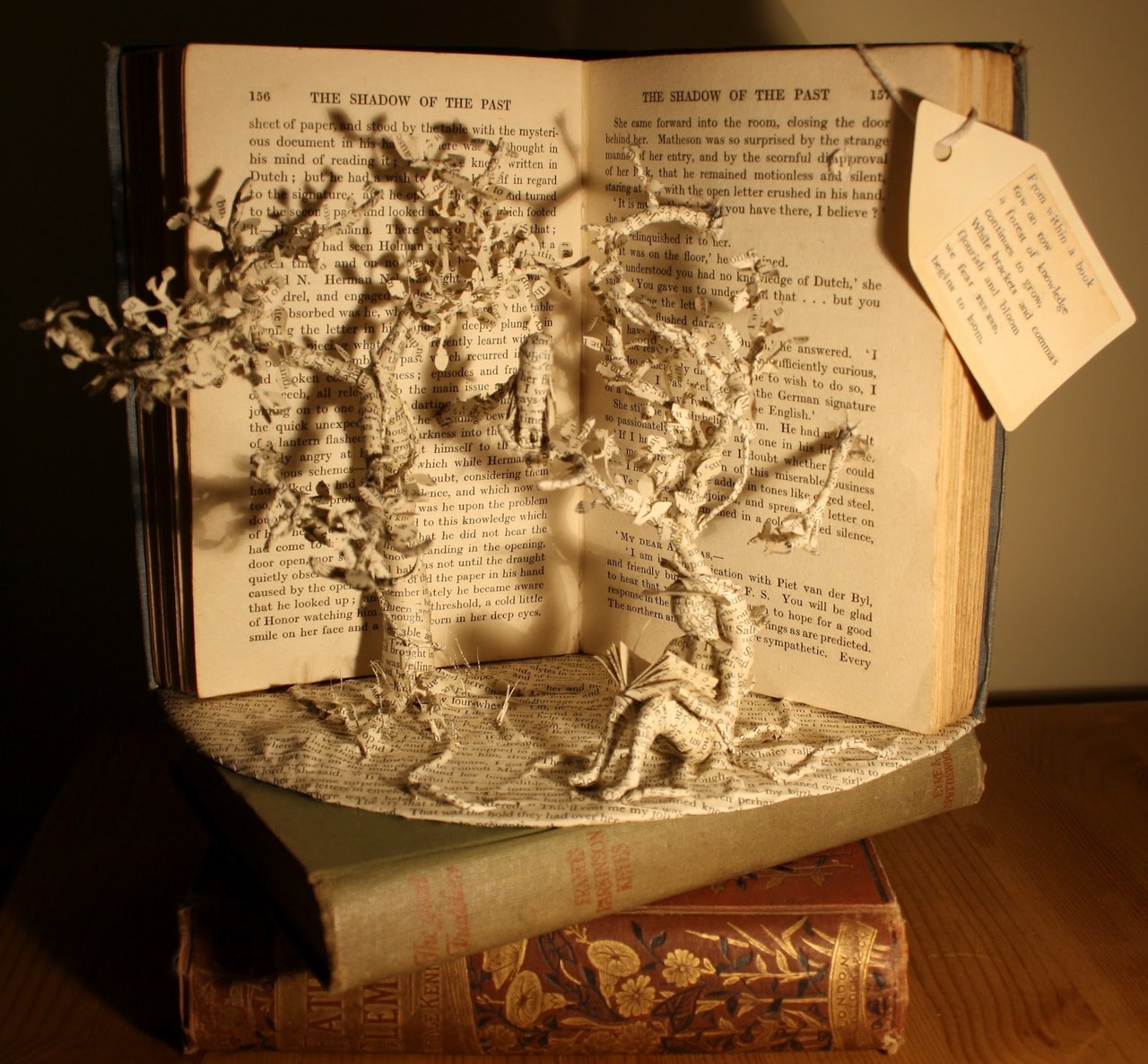
Book Artists

Brian Dettmer


Emma Taylor


Friday, January 29, 2016

Performative Function Through Swapping Dialects

I guess I didn't really have a form unique to mixed media in the "Of Geese and Finance" shot, but I think I have one in the "Butcher Shop Interior" and "Panhandler" shots.
I am not sure what kind of function the "Butcher Shop Interior" is. It sort of changes from implicit to explicit as the text transforms into characters. All of my cross over tropes sort of go from constative to performative by virtue of swapping dialects between literary and cinematography through interactivity. In a sense they were never really performative functions, because they were never purely constave in the other platform. But that leads back to the problem that you cannot make a statement to another without eliciting some sort of reaction (or it is not really communication). In that light, the crossover performative functions are more perfect than a performative function in a single platform because they do not exist as statements at all in the other medium... But that might make them less than utterances.
I don't think a constative utterance can exist, but performatives are a gradation from implicit to explicit, and time based media can go from not existing -> to implicit  -> to explicit as the message is revealed to the audience.

Thursday, January 28, 2016

Chompskybot

http://rubberducky.org/cgi-bin/chomsky.pl


Possibly brilliant... Possibly terrifying, because I am starting to sound like this.

Time Based Performative Function or The Transformative Performative Function©

It seems a constative could be a transforming performative with the mood primitive in any time based format...

A dramatic pause can be a performative function that happens with time if the perception of the statement changes from informative to performative while the audience is watching; eliciting a psychological reaction.

For example:

If you start the statement masquerading as an informative*, but add a mood primitive, that is not initially apparent, the temporal offset adds punctuation.

If you wanted an audience to identify with a protagonist. Creating a scene where the antagonist was smiling and saying "there is the door" in the tone of an informative statement, and then holding eye contact too long while the smile fades into an angry glare. The protagonist's lag interpreting the situation (because the information was intentionally misleading) would suggest the recipient was slow to understand. If successful, the audience would also experience the confusion, identifying with the protagonist.
This seems like the kind of thing that is used in cinematography, but I cannot think of an example right now.

*If you accept that one could make an informative statement with no anticipated evocation. It could be argued as an implicit performative; intended to prevent someone from making actions, or to assert yourself as helpful to get others to treat you in a certain manner.